Showing posts with label political science. Show all posts

Saturday, July 9, 2011

Mobilizing Dissent in Tripoli

Observers of authoritarianism are aware that one of the hardest obstacles for opposition to overcome is the unknown: the number of people unknown to opposition leaders who do not support the regime and could potentially be induced to act against it, but remain silent out of fear. If an authoritarian regime is effective in atomizing society and hindering free speech, even in private, people will be unable to gauge the extent of public dissatisfaction in existence, making opposition action seem highly risky. No one knows if a person makes a public stance, will others join and support him?  (See Lisa Wedeen’s readable and informative account of this phenomenon in Syria)

In Tripoli, still under the tight grip of Moammar Qaddhafi, fear still prevails. One activist, however, is displaying his defiance in an effort to rally the citizens of Tripoli into action. In a story on CNN, he admits to burning a mural of Qaddhafi in broad daylight – a brazen act by any standards – and explains his motivations.

He said he hurled a Molotov cocktail and set one of the capital's largest Gadhafi posters afire. "It is symbolic because it is in the heart of Tripoli," he said. "It has been what some people have been calling a city devoid of opposition to Gadhafi."

According to CNN, “Niz [pseudonym of the activist] is not alone in his viewpoint: there exists in Tripoli a large, frightened group of people who oppose Gadhafi. Niz hopes to push them into action.”

It is actions like these that started the revolt in Syria. Only by starting with actions like these can people sitting on the fence or frozen in fear be motivation to action.

See the CNN story here:

Displays of Defiance in Tripoli

Wednesday, July 6, 2011

Did Middle East Studies Miss the Arab Spring?

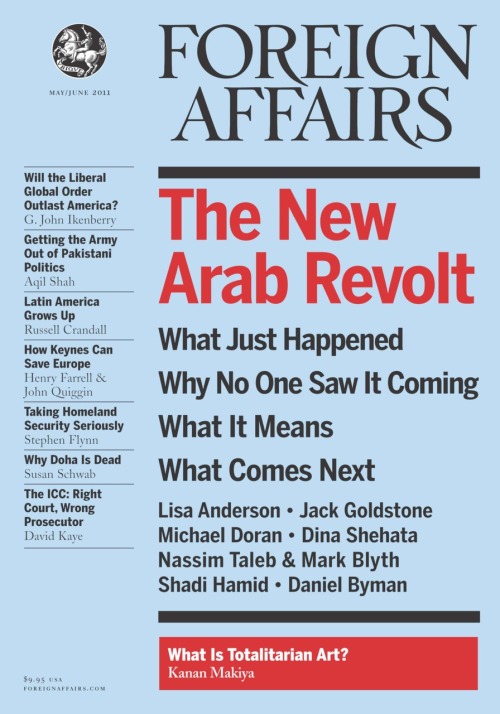
FAIssueThe new Foreign Affairs issue features an article by F. Gregory Gause III who argues that Middle East scholars – himself included – did not see the unprecedented events of the so-called “Arab Spring” coming and were as surprised as everyone else when events unfolded as they did. He attributes this to three factors underappreciated by scholars: 1) civil-military relations, 2) state-economy interactions, and 3) strong Pan-Arab sentiments.

Gause hits the issue dead on regarding the first issue. Civil-military relations have indeed been low on the academic agenda in Middle Eastern studies since the spate of military coups of the 1950s and 1960s abated. There were the few, like Steven Cook, who wrote about Arab (not Turkish or Israeli) military relations, but by and large, most scholars seemed to prefer writing about social capital or other trendy issues.

In my mind, civil-military relations sounded like a boring and irrelevant subject, something that Latin American specialists did and was relevant to their region. But ever since the militaries of Tunisia and Egypt turned on their benefactors, the military of Libya fragmented, and Syria’s (apparently) remained steadfast in its loyalty to the dictator, I have come to appreciate the complexity and importance of military politics. Gause will find little argument from me on this point.

However, it is not altogether clear that had scholars focused more on civil-military relations, the events of the Arab Spring would have been less of a surprise. It would have indeed provided evidence of the fragility of these regimes, but in fact, such evidence has not been lacking. Gause’s second factor is a case in point. He argues that Middle East scholars underestimated the destabilizing effect of neoliberal economic reforms on non-oil-rich states. Two points are relevant here:

1. While Gause is probably correct in his related assertion that oil-rich states remain relatively stable, I believe that this issue needs to be investigated in light of the events in Libya and Bahrain. The uprisings in those two countries can be blamed on contingent factors, like ethnic strains or economic waste, as Gause does, but it is far from established that these contingent factors are responsible for allowing mobilization to grow much further than the regimes’ comfort levels. I will feel more comfortable in such assertions after systematic studies have been done.

2. More to the point, Gause’s argument about the destabilizing effect of neoliberal economic reforms is not news to Middle East scholars. Many scholars in fact have argued all along that the status quo was inherently destabilizing and unsustainable, whether because of the austerity of structural adjustment programs, growing corruption, unpopular American hegemony over the region, or ideologically bankrupt, authoritarian regimes. Particularly problematic (in my eyes, at least) was the exclusion of the younger generations from the “ruling bargain” of the 1950s and 1960s due to contracting state financial obligations.

After some time, it became difficult for scholars explain the persistence of these regimes, given all the reasons for discontent. Thus, the scholarly focus began to shift to authoritarian stability, not because there were no reasons to believe instability would occur, but precisely because there were so many. Scholars cannot ignore empirical reality; Mubarak’s 31 years in power, Assad’s (Hafez) 29 years and his son’s subsequent 11 years (so far), Qaddhafi’s 41 years, and so on, need to be explained given the very real expectations that such long-term authoritarian, corrupt rule would not succeed.

The question now, after the events to date of the Arab Spring, should most appropriately be “why now?” rather than focusing on why it happened in the first place. Why did the revolts occur this year, rather than last year or ten years ago? This is a much trickier question, one that could involve both contingent events and others related to systematic factors.

I think that previous research has given scholars clues as to some important factors worth investigating. The first comes from social movement scholarship, which has influenced many studies of Middle Eastern issues in recent years. Social movement scholars point to movements’ opportunities, strategies, and capacities to organize, rather than simply looking at the existence of grievances to explain variations in social movement activity. While the details have yet to fully emerge, it appears that the youth of countries like Egypt and Tunisia, and possibly others, like Syria, have been organizing for several years, not simply to voice their protest, but with the intent of carrying out a nonviolent revolution.  Discontented and not beholden to their regime’s ruling bargain, the youth organized both on the ground and in cyberspace to eventually capture the imagination of a large segment of their country’s population.

This brings us to a second factor, the highly important but difficult to predict “snowball effect.” Once a critical mass of individuals are seen defying authorities (to protest, for example), others are more likely to perceive lower risk to themselves and therefore more likely to join the defiance. This is well explained by Timur Kuran in a 1991 article in World Politics, “Now Out of Never: The Element of Surprise in the East European Revolution of 1989.” It is often contingent and unpredictable events, however, that are the triggering events for such snowball effects, making them difficult to predict. Making prediction even harder is the fact that citizens of authoritarian regimes have an incentive to hide their true preferences from others, out of fear of the authorities, until the snowball cascade is well underway. Despite these apparently unsystematic factors influencing the outcome, it is nevertheless apparent that some sort of cascade similar to what Kuran described has recently been at work in many countries.

Further investigation of these two factors may uncover important clues to answering the question of “why now?” While much works remains to be done, significant scholarly groundwork has been done by scholars preceding the Arab Spring, giving us much to build upon. Although it is important to look at what scholars missed before the events of the last few months, it is equally, if not more important, to look at what they did NOT miss, and use it in future scholarship on successful and unsuccessful uprisings. Scholars, while pleasantly surprised by the Arab Spring, may have missed less than we think.

Tuesday, June 28, 2011

What I Think I Know about Reform in Jordan and Morocco: Two Kings’ Speeches

As the media spotlight remains fixed on the uprisings taking place in “rogue states” Libya and Syria, a quiet revolution appears to be occurring in the western-friendly monarchical regimes of Morocco and Jordan. In each of these countries, a robust protest movement has been calling for significant political reforms, and the regime has responded with what appears to be earth-shaking proposals.

While the protesters have not been demanding the now famous “downfall of the regime” – essentially the overthrow of family rule – they have been calling for reforms that essentially seek the same thing: transforming the regime into a constitutional monarchy with the king as royal figurehead. The protesters seem to envision a political system whereby the majority of political power rests in a freely elected parliament and prime minister, relatively unhindered by royal interference.
In Jordan, King Abdullah recently announced reforms that would result in “fairness and transparency in the electoral process” and a “Parliament with active political party representation… that allows the formation of governments based on parliamentary majority…”

In Morocco, King Mohammed VI proposed constitutional changes that would significantly reduce his powers. The reforms are meant to ensure that the government is formed from the majority party, while taking the power to appoint government officials and to dissolve parliament away from the king. The proposed reforms are to be voted upon in a national referendum on July 1.

These reforms have been hailed as nothing short of revolutionary, by many observers both inside and outside the region. But how revolutionary are they?

In the case of Morocco, where the proposed reforms are set to be voted upon and – if approved – implemented in a matter of a few months, questions remain regarding the king’s ability to manipulate politics. Critics called the proposed constitutional changes “cosmetic” and pointed to the king’s position in the new constitution as head of state and head of the military – a politically and strategically important position, as recent events in Tunisia and Egypt have shown. The text of the reforms does not back up the promise of a limited constitutional monarchy, according to some, as it is “drowned” in a sea of qualifiers. Since the political parties are weak and beholden to the king, any promise to give parties the lead in politics may simply obscure the unchanged role of royal maneuvering behind the scenes.

In the case of Jordan, King Abdullah’s after-the-fact clarifications indicated that his proposed reforms would not come into effect for two to three years, after Jordan’s political parties had time to “mature” and consolidate into two or three main parties. This has led to charges from critics that the proposal is merely a delaying tactic, or at best, a means to control the process to ensure that the opposition he must work with is sufficiently pliable.

Even if Abdullah’s reforms are implemented, critics expect a continued underrepresentation of leftists and Islamists in Jordan’s parliament, a long-standing tradition in the royal politics of the country.

However, how realistic is it to expect the country’s 33 political parties t0 consolidate into two or three main parties in the absence of institutional inducements to do so? As students of politics observe, different electoral systems and arrangements result in quite different political party systems. Where a single winner is selected from a district by majority/plurality vote, as in the United States, parties have an incentive to merge and ideologies tend toward the center. Other electoral methods may have different outcomes, like the well-known proportional representation system in which multiple winners are elected from a single or few country-wide districts based on their party’s percentage of the vote garnered in the election. Here, the tendency is for multiple parties to exist, as a party may gain seats with a relatively small percentage of votes. In non-democratic systems or hybrid regimes, parties serve different functions than representing constituents views. This has been aptly illustrated in the case of Jordan by Ellen Lust-Okar.

The point here is that can we expect Jordan’s political parties to organically merge simply because they are told to do so? And if they do, will they be able to transform themselves from instruments of patronage to instruments of national representation? Political scientists would look to the institutional arrangements for clues as to the likelihood of these things happening, but alas, we have no concrete details to examine. Even more disheartening is the fact that King Abdullah apparently expects party transformation to precede the constitutional reforms, not follow them. Unfortunately, I am skeptical of this succeeding.

Although it seems that the reforms proposed in Jordan and Morocco have bedazzled the eyes of western observers, it does not appear to me that the region has found a peaceful “royal road to democracy.”

In both cases, King Abdullah and Mohammed VI seem to want to defuse international and moderate domestic critics while keeping the lion’s share of power in royal family hands. While the reforms, in the long run, may represent a step forward, it is only a small step forward in what may be a very long journey ahead.

Saturday, February 19, 2011

The "Leaderless, Spontaneous" Revolution that Wasn't

The "leaderless" "social media" revolutions in Tunisia and Egypt have struck me as requiring some explanation. Revolutions don't just happen. Revolutionaries plan for them, in painstaking manner. They only succeed under certain structural conditions. No matter how unhappy people are with Mubarak, something must happen to change the political environment from one in which protesters are few and outnumbered (and arrested) by police, to one in which protesters can completely overwhelm the police with their sheer numbers, as occurred in Egypt January 28th and subsequent days.

I expressed my doubts in a previous post, and said I would update as my understanding of the situation developed. Now I can (briefly) update with some additional information.

Newsbreak: The revolution was not leaderless. It simply didn't have a "face" already known to western media, like Mohamed AlBaradei. Instead, young leaders eschewed the media limelight. Organizing, not posturing, seemed to be their main task.

More: Twitter and Facebook did not "make" this revolution; people did. Their hard work organizing people on the ground is what made this happen.

More on all this later, but for now, I'll simply post a few links to essential reading on the details of my argument.

Wired and Shrewd, Young Egyptians Guide Revolt

An Egyptian and Tunisian Link that Shook History

Revolution U: What Egypt Learned from the Students who Ovethrew Milosevic

The Hopeful Network: Meet the Young Cyberactivists who have been Planning Egypt's Revolution for Years

Friday, January 14, 2011

Arab Authoritarianism Given a Blow by Tunisian People Power

Anyone watching the events in Tunisia today has to be thrilled by the magnitude of what has apparently happened. An autocrat firmly entrenched in power for 23 years in a country widely thought to be among the most prosperous and stable was chased from power by massive street demonstrations. Rulers in neighboring Arab countries who refuse to relinquish power in their own countries, despite high unemployment and rising discontent, almost certainly are watching Tunisia with great concern for what could eventually come to their own shores.
Despite the euphoria, the political scientist in me is asking many questions: why did this happen now, and not six months ago or two years ago? And what’s next? Will the protesters’ calls for greater democracy, transparency, and economic equality be heeded by the new leaders?
It’s not at all clear that the interim leader, Mohammed Ghannouchi, will steer a new course entirely different from his predecessor, Zine el Abidine Ben Ali. He is described as a “yes man” (or more correctly, “Mr. Oui Oui”) by Blake Hounshell on Foreign Policy’s blog for always saying “yes” to Ben Ali. The Tunisian people will have to change the familiar course of history to influence the new regime in the direction it wants to go. This is not an easy proposition, given that Tunisia’s opposition is generally characterized as weak and fragmented from years of Ben Ali’s cooptation and repression.
This brings me to a second point, which is “why now"?” Tunisia seems an unlikely candidate for a people power revolution, particularly given the weakness of its opposition movements. In fact, Tunisia is held up as an example of successful opposition exclusion and repression – and therefore thwarted rebellion – in one of my favorite books explaining revolutions and revolts, Why Muslims Rebel by Mohammed Hafez. Now, I think, Dr. Hafez has some splainin’ to do.
But Hafez’s book and others in the same political process tradition are very good at asking and answering the question of “why now?” about rebellions. By looking at the nature of political institutions, regime practices and opposition organizations, we can get a better understanding of the conditions that allow successful (variously defined) rebellions to form and flourish.
Most of the news reports have pointed to youth discontent over unemployment, corruption, and lack of freedom in Tunisia as the cause for the rebellions. I remain unconvinced that this is the strongest explanation for what is happening. While discontent is never irrelevant, it is unlikely to explain why this is happening now rather than a year ago. Was discontent substantially lower a year ago? Two months ago? I doubt it.
So I am planning to look a little deeper than the standard explanations to the nature of opposition organizations and (more likely) to the opportunities for opposition mobilization presented by the regime as it slowly weakened and lost its grip on power. I’ll keep ya posted.

Tuesday, April 21, 2009

Planned Irrelevance

I am irrelevant.

At least that’s what Joseph Nye says, who happens to be an influential Harvard University professor and Dean, and a former Assistant Secretary of Defense in the Clinton administration. According to Nye, political scientists are increasingly becoming more and more irrelevant to the policy-making world. In an opinion essay published in last week's Washington Post Nye opines that political science academics are too interested in jargon-filled mathematical models, new methodologies and theories that are unintelligible to most policy makers. To write articles on policy issues is not only unrewarded in most political science departments, but can also be the kiss of death to aspirations for career advancement. Few academics serve in policy making positions. Academics have only themselves to blame if their ideas have little impact on the policy world, Nye says.

Well, yes and no.

First, I’d like to suggest that there are in fact some ways that political scientists contribute to policy debates in ways other than publishing research on policy issues. First of all, we teach students policy relevant topics. We don’t just teach theory, we also teach policy, current events, and most importantly, critical thinking and writing skills that (we hope) transfer to the job market and citizenship at large. Political scientists are also frequently called upon to comment to the media, give talks to audiences large and small, host and participate in debates, usually on policy-related issues. We prognosticate, debate and try to guess the motivations of leaders’ moves on the chessboard. Much of what we do other than research is quite relevant to Washington.

Also, it is important to note, that not all research needs to be (or should be) directly policy relevant. The value of research should not be measured by purely instrumental means. That was the entire purpose of academia – to provide a place where academics can pursue the study of some things deemed without value by the free market economy – like the study of philosophy or literature – but that a civilized society believes should be pursued for its own intrinsic value.

In my opinion, comparative politics theory is just plain interesting, but the study of labor relations is not. Is one more important than the other? The “soaking and poking” involved in getting to know a foreign country intimately is enormously fun! It can also provide a lot of the background knowledge necessary to form some of the “expert” opinions about a country or region. Policy analysts actually need that sort of information.

However, on the whole, Nye is correct in his assessment. It is an uncomfortable position to be in to be told you and your line of work is “irrelevant.” Even worse, to largely agree. Even though most jargon-filled articles have some degree of relevance to the real world, that relevance is often tangential. The greatest measure of the worth of research, in most academics’ eyes, is its contribution to “theory building.” Admirable, yes, but overblown in importance by far.

And to fight against that tide is a losing battle. Particularly as junior faculty. One must follow the “dominant culture” for the most part, if one is to get tenure. Play the game, play well, and play nice. This means many things, but in research it means careful attention to theory more than policy relevance.

This problem has been discussed before (see Larry Diamond’s article here, and Robert Putnam’s APSA address here), but it seems that changing the dominant culture is like turning a gigantic oil tanker on a dime. Change must be initiated by a critical mass of the “powerful” in academia, a trend not likely to appear any time soon.

I’m not one of the powerful. The revolution will not start with me.