Showing posts with label Middle East. Show all posts

Wednesday, July 6, 2011

Did Middle East Studies Miss the Arab Spring?

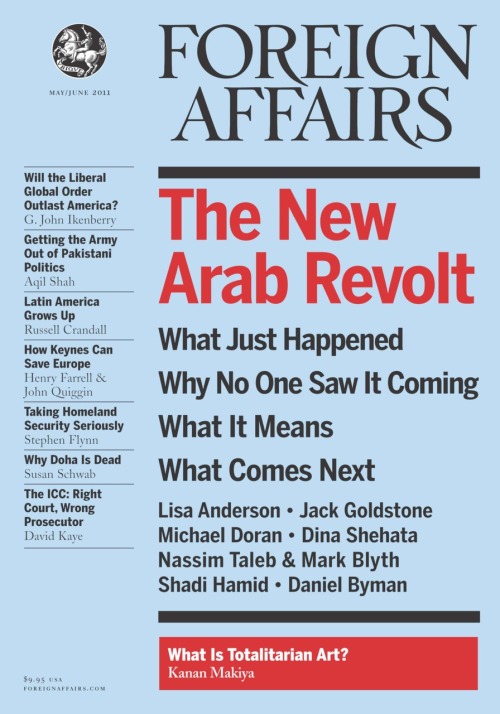
FAIssueThe new Foreign Affairs issue features an article by F. Gregory Gause III who argues that Middle East scholars – himself included – did not see the unprecedented events of the so-called “Arab Spring” coming and were as surprised as everyone else when events unfolded as they did. He attributes this to three factors underappreciated by scholars: 1) civil-military relations, 2) state-economy interactions, and 3) strong Pan-Arab sentiments.

Gause hits the issue dead on regarding the first issue. Civil-military relations have indeed been low on the academic agenda in Middle Eastern studies since the spate of military coups of the 1950s and 1960s abated. There were the few, like Steven Cook, who wrote about Arab (not Turkish or Israeli) military relations, but by and large, most scholars seemed to prefer writing about social capital or other trendy issues.

In my mind, civil-military relations sounded like a boring and irrelevant subject, something that Latin American specialists did and was relevant to their region. But ever since the militaries of Tunisia and Egypt turned on their benefactors, the military of Libya fragmented, and Syria’s (apparently) remained steadfast in its loyalty to the dictator, I have come to appreciate the complexity and importance of military politics. Gause will find little argument from me on this point.

However, it is not altogether clear that had scholars focused more on civil-military relations, the events of the Arab Spring would have been less of a surprise. It would have indeed provided evidence of the fragility of these regimes, but in fact, such evidence has not been lacking. Gause’s second factor is a case in point. He argues that Middle East scholars underestimated the destabilizing effect of neoliberal economic reforms on non-oil-rich states. Two points are relevant here:

1. While Gause is probably correct in his related assertion that oil-rich states remain relatively stable, I believe that this issue needs to be investigated in light of the events in Libya and Bahrain. The uprisings in those two countries can be blamed on contingent factors, like ethnic strains or economic waste, as Gause does, but it is far from established that these contingent factors are responsible for allowing mobilization to grow much further than the regimes’ comfort levels. I will feel more comfortable in such assertions after systematic studies have been done.

2. More to the point, Gause’s argument about the destabilizing effect of neoliberal economic reforms is not news to Middle East scholars. Many scholars in fact have argued all along that the status quo was inherently destabilizing and unsustainable, whether because of the austerity of structural adjustment programs, growing corruption, unpopular American hegemony over the region, or ideologically bankrupt, authoritarian regimes. Particularly problematic (in my eyes, at least) was the exclusion of the younger generations from the “ruling bargain” of the 1950s and 1960s due to contracting state financial obligations.

After some time, it became difficult for scholars explain the persistence of these regimes, given all the reasons for discontent. Thus, the scholarly focus began to shift to authoritarian stability, not because there were no reasons to believe instability would occur, but precisely because there were so many. Scholars cannot ignore empirical reality; Mubarak’s 31 years in power, Assad’s (Hafez) 29 years and his son’s subsequent 11 years (so far), Qaddhafi’s 41 years, and so on, need to be explained given the very real expectations that such long-term authoritarian, corrupt rule would not succeed.

The question now, after the events to date of the Arab Spring, should most appropriately be “why now?” rather than focusing on why it happened in the first place. Why did the revolts occur this year, rather than last year or ten years ago? This is a much trickier question, one that could involve both contingent events and others related to systematic factors.

I think that previous research has given scholars clues as to some important factors worth investigating. The first comes from social movement scholarship, which has influenced many studies of Middle Eastern issues in recent years. Social movement scholars point to movements’ opportunities, strategies, and capacities to organize, rather than simply looking at the existence of grievances to explain variations in social movement activity. While the details have yet to fully emerge, it appears that the youth of countries like Egypt and Tunisia, and possibly others, like Syria, have been organizing for several years, not simply to voice their protest, but with the intent of carrying out a nonviolent revolution.  Discontented and not beholden to their regime’s ruling bargain, the youth organized both on the ground and in cyberspace to eventually capture the imagination of a large segment of their country’s population.

This brings us to a second factor, the highly important but difficult to predict “snowball effect.” Once a critical mass of individuals are seen defying authorities (to protest, for example), others are more likely to perceive lower risk to themselves and therefore more likely to join the defiance. This is well explained by Timur Kuran in a 1991 article in World Politics, “Now Out of Never: The Element of Surprise in the East European Revolution of 1989.” It is often contingent and unpredictable events, however, that are the triggering events for such snowball effects, making them difficult to predict. Making prediction even harder is the fact that citizens of authoritarian regimes have an incentive to hide their true preferences from others, out of fear of the authorities, until the snowball cascade is well underway. Despite these apparently unsystematic factors influencing the outcome, it is nevertheless apparent that some sort of cascade similar to what Kuran described has recently been at work in many countries.

Further investigation of these two factors may uncover important clues to answering the question of “why now?” While much works remains to be done, significant scholarly groundwork has been done by scholars preceding the Arab Spring, giving us much to build upon. Although it is important to look at what scholars missed before the events of the last few months, it is equally, if not more important, to look at what they did NOT miss, and use it in future scholarship on successful and unsuccessful uprisings. Scholars, while pleasantly surprised by the Arab Spring, may have missed less than we think.

Tuesday, June 28, 2011

What I Think I Know about Reform in Jordan and Morocco: Two Kings’ Speeches

As the media spotlight remains fixed on the uprisings taking place in “rogue states” Libya and Syria, a quiet revolution appears to be occurring in the western-friendly monarchical regimes of Morocco and Jordan. In each of these countries, a robust protest movement has been calling for significant political reforms, and the regime has responded with what appears to be earth-shaking proposals.

While the protesters have not been demanding the now famous “downfall of the regime” – essentially the overthrow of family rule – they have been calling for reforms that essentially seek the same thing: transforming the regime into a constitutional monarchy with the king as royal figurehead. The protesters seem to envision a political system whereby the majority of political power rests in a freely elected parliament and prime minister, relatively unhindered by royal interference.
In Jordan, King Abdullah recently announced reforms that would result in “fairness and transparency in the electoral process” and a “Parliament with active political party representation… that allows the formation of governments based on parliamentary majority…”

In Morocco, King Mohammed VI proposed constitutional changes that would significantly reduce his powers. The reforms are meant to ensure that the government is formed from the majority party, while taking the power to appoint government officials and to dissolve parliament away from the king. The proposed reforms are to be voted upon in a national referendum on July 1.

These reforms have been hailed as nothing short of revolutionary, by many observers both inside and outside the region. But how revolutionary are they?

In the case of Morocco, where the proposed reforms are set to be voted upon and – if approved – implemented in a matter of a few months, questions remain regarding the king’s ability to manipulate politics. Critics called the proposed constitutional changes “cosmetic” and pointed to the king’s position in the new constitution as head of state and head of the military – a politically and strategically important position, as recent events in Tunisia and Egypt have shown. The text of the reforms does not back up the promise of a limited constitutional monarchy, according to some, as it is “drowned” in a sea of qualifiers. Since the political parties are weak and beholden to the king, any promise to give parties the lead in politics may simply obscure the unchanged role of royal maneuvering behind the scenes.

In the case of Jordan, King Abdullah’s after-the-fact clarifications indicated that his proposed reforms would not come into effect for two to three years, after Jordan’s political parties had time to “mature” and consolidate into two or three main parties. This has led to charges from critics that the proposal is merely a delaying tactic, or at best, a means to control the process to ensure that the opposition he must work with is sufficiently pliable.

Even if Abdullah’s reforms are implemented, critics expect a continued underrepresentation of leftists and Islamists in Jordan’s parliament, a long-standing tradition in the royal politics of the country.

However, how realistic is it to expect the country’s 33 political parties t0 consolidate into two or three main parties in the absence of institutional inducements to do so? As students of politics observe, different electoral systems and arrangements result in quite different political party systems. Where a single winner is selected from a district by majority/plurality vote, as in the United States, parties have an incentive to merge and ideologies tend toward the center. Other electoral methods may have different outcomes, like the well-known proportional representation system in which multiple winners are elected from a single or few country-wide districts based on their party’s percentage of the vote garnered in the election. Here, the tendency is for multiple parties to exist, as a party may gain seats with a relatively small percentage of votes. In non-democratic systems or hybrid regimes, parties serve different functions than representing constituents views. This has been aptly illustrated in the case of Jordan by Ellen Lust-Okar.

The point here is that can we expect Jordan’s political parties to organically merge simply because they are told to do so? And if they do, will they be able to transform themselves from instruments of patronage to instruments of national representation? Political scientists would look to the institutional arrangements for clues as to the likelihood of these things happening, but alas, we have no concrete details to examine. Even more disheartening is the fact that King Abdullah apparently expects party transformation to precede the constitutional reforms, not follow them. Unfortunately, I am skeptical of this succeeding.

Although it seems that the reforms proposed in Jordan and Morocco have bedazzled the eyes of western observers, it does not appear to me that the region has found a peaceful “royal road to democracy.”

In both cases, King Abdullah and Mohammed VI seem to want to defuse international and moderate domestic critics while keeping the lion’s share of power in royal family hands. While the reforms, in the long run, may represent a step forward, it is only a small step forward in what may be a very long journey ahead.

Thursday, May 19, 2011

Obama's 'Arab Spring' Speech, Storified

I have discovered Storify, the website where you can piece together tweets and other multimedia to tell a "story," in this case, all the liveblogging of Obama's speech. I only captured a small bit of it, but here is my effort so far:
Obama's Mideast Speech on Storify
Here is one by the Washington Post as well. Very professionally done but without much of the color commentary that makes this sort of thing interesting.
Enjoy!

Sunday, February 20, 2011

Freedom for Egyptians Only?

As dictators across the Middle East open fire on nonviolent citizen protesters, the US remains on the sidelines. Bahrain, Algeria, and Libya have clamped down on media coverage, making these uprisings are much less visible to everyday Americans than the Egyptian uprising, which garnered 24/7 news coverage during its peak.

Protesters putting their lives on the line should not feel abandoned. While they are indigenous, capable movements, they are at the mercy of their police and military establishments. In Bahrain and especially Libya, the relative “restraint” shown by Egypt appear to have been abandoned. The message learned from Egypt: crack down hard and early, before protests become too large.

I hope the Obama administration is not intimidated by the importance of the 5th Fleet’s home in Bahrain. No amount of blood is worth a naval base, even one that serves to pressure Iran and safeguard important oil shipping lanes in the Persian Gulf. The US should make it clear that we stand up for the rights of all who desire freedom, even those with the unfortunate bad luck of living where we have placed an important naval base.

Freedom is for all, not just a chosen few.

Saturday, August 15, 2009

“The Sorrowful Decline of the Arabs”

“The Sorrowful Decline of the Arabs”: "

"In the Wall Street Journal, Fouad Ajami writes today that the vibrant display of political activism in Iran since its elections highlights the relative “stagnation” of politics in the Arab world. He writes that the recent UN Arab Human Development Report dissects the condition of the Arab state and sadly recognizes that despite oil wealth, the region has an autocratic political culture, high unemployment, floundering economies and widespread poverty. States have failed their people, contends Ajami, but leaders have nevertheless become masters of personal political survival, which is reinforced by shortcomings in strong opposition movements, the middle class, and power of property the private sector.

Ajami is critical of the UN Arab Human Development Report’s authors, but narrows his argument to criticize a new American policy in the Middle East under President Obama. This policy values the status quo over the “risks of liberty,” he writes, and misses opportunities at supporting democracy." (Project on Middle East Democracy)

One of the most notable things about the Iranian Uprising is the relative quiet in the Arab world. Even the Egyptian Kefeya movement cannot mobilize more than a few dozen protesters, while Iranian dissenters were able to fill the streets with thousands. One could speculate as to the reasons for the difference. Ajami seems to imply it is cultural, as if the Arabs were somehow incompetent or growing more impotent without Washington's prodding. In fact, if one were to draw any conclusions about American influence, it might be the opposite: where American influence is the weakest (Iran) democratic impulses are the strongest. Only where American influence props up dictators and stifles civil society do popular movements fail.

Tuesday, June 9, 2009

Obama's Mideast Move


President Obama's speech to the Muslim world given from Cairo last Thursday struck all the right notes. By sympathizing with the Palestinians and calling for a settlement freeze, he suggests a more balanced approach than recent American administrations. But he also denounced anti-Semitism in the Mideast and sympathized with the plight of the Jews after the Holocaust. He underscored America's strong friendship with Israel and its permanence. So Obama plans to keep Israel but with some much needed "tough love" and truth telling.
The extremes on all sides were not satisfied with the speech, of course. And all are waiting to see if the nice words will be translated into action. All sides want peace, but on their own terms. With a right-wing Israeli government in power and the Palestinians severely divided, achieving any progress on the peace front will be extremely difficult.
Sent via BlackBerry by AT&T