Showing posts with label Arabs. Show all posts

Wednesday, July 6, 2011

Did Middle East Studies Miss the Arab Spring?

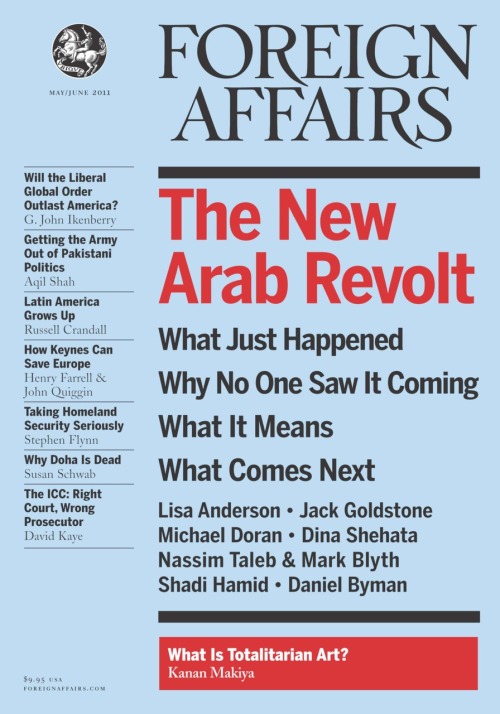
FAIssueThe new Foreign Affairs issue features an article by F. Gregory Gause III who argues that Middle East scholars – himself included – did not see the unprecedented events of the so-called “Arab Spring” coming and were as surprised as everyone else when events unfolded as they did. He attributes this to three factors underappreciated by scholars: 1) civil-military relations, 2) state-economy interactions, and 3) strong Pan-Arab sentiments.

Gause hits the issue dead on regarding the first issue. Civil-military relations have indeed been low on the academic agenda in Middle Eastern studies since the spate of military coups of the 1950s and 1960s abated. There were the few, like Steven Cook, who wrote about Arab (not Turkish or Israeli) military relations, but by and large, most scholars seemed to prefer writing about social capital or other trendy issues.

In my mind, civil-military relations sounded like a boring and irrelevant subject, something that Latin American specialists did and was relevant to their region. But ever since the militaries of Tunisia and Egypt turned on their benefactors, the military of Libya fragmented, and Syria’s (apparently) remained steadfast in its loyalty to the dictator, I have come to appreciate the complexity and importance of military politics. Gause will find little argument from me on this point.

However, it is not altogether clear that had scholars focused more on civil-military relations, the events of the Arab Spring would have been less of a surprise. It would have indeed provided evidence of the fragility of these regimes, but in fact, such evidence has not been lacking. Gause’s second factor is a case in point. He argues that Middle East scholars underestimated the destabilizing effect of neoliberal economic reforms on non-oil-rich states. Two points are relevant here:

1. While Gause is probably correct in his related assertion that oil-rich states remain relatively stable, I believe that this issue needs to be investigated in light of the events in Libya and Bahrain. The uprisings in those two countries can be blamed on contingent factors, like ethnic strains or economic waste, as Gause does, but it is far from established that these contingent factors are responsible for allowing mobilization to grow much further than the regimes’ comfort levels. I will feel more comfortable in such assertions after systematic studies have been done.

2. More to the point, Gause’s argument about the destabilizing effect of neoliberal economic reforms is not news to Middle East scholars. Many scholars in fact have argued all along that the status quo was inherently destabilizing and unsustainable, whether because of the austerity of structural adjustment programs, growing corruption, unpopular American hegemony over the region, or ideologically bankrupt, authoritarian regimes. Particularly problematic (in my eyes, at least) was the exclusion of the younger generations from the “ruling bargain” of the 1950s and 1960s due to contracting state financial obligations.

After some time, it became difficult for scholars explain the persistence of these regimes, given all the reasons for discontent. Thus, the scholarly focus began to shift to authoritarian stability, not because there were no reasons to believe instability would occur, but precisely because there were so many. Scholars cannot ignore empirical reality; Mubarak’s 31 years in power, Assad’s (Hafez) 29 years and his son’s subsequent 11 years (so far), Qaddhafi’s 41 years, and so on, need to be explained given the very real expectations that such long-term authoritarian, corrupt rule would not succeed.

The question now, after the events to date of the Arab Spring, should most appropriately be “why now?” rather than focusing on why it happened in the first place. Why did the revolts occur this year, rather than last year or ten years ago? This is a much trickier question, one that could involve both contingent events and others related to systematic factors.

I think that previous research has given scholars clues as to some important factors worth investigating. The first comes from social movement scholarship, which has influenced many studies of Middle Eastern issues in recent years. Social movement scholars point to movements’ opportunities, strategies, and capacities to organize, rather than simply looking at the existence of grievances to explain variations in social movement activity. While the details have yet to fully emerge, it appears that the youth of countries like Egypt and Tunisia, and possibly others, like Syria, have been organizing for several years, not simply to voice their protest, but with the intent of carrying out a nonviolent revolution.  Discontented and not beholden to their regime’s ruling bargain, the youth organized both on the ground and in cyberspace to eventually capture the imagination of a large segment of their country’s population.

This brings us to a second factor, the highly important but difficult to predict “snowball effect.” Once a critical mass of individuals are seen defying authorities (to protest, for example), others are more likely to perceive lower risk to themselves and therefore more likely to join the defiance. This is well explained by Timur Kuran in a 1991 article in World Politics, “Now Out of Never: The Element of Surprise in the East European Revolution of 1989.” It is often contingent and unpredictable events, however, that are the triggering events for such snowball effects, making them difficult to predict. Making prediction even harder is the fact that citizens of authoritarian regimes have an incentive to hide their true preferences from others, out of fear of the authorities, until the snowball cascade is well underway. Despite these apparently unsystematic factors influencing the outcome, it is nevertheless apparent that some sort of cascade similar to what Kuran described has recently been at work in many countries.

Further investigation of these two factors may uncover important clues to answering the question of “why now?” While much works remains to be done, significant scholarly groundwork has been done by scholars preceding the Arab Spring, giving us much to build upon. Although it is important to look at what scholars missed before the events of the last few months, it is equally, if not more important, to look at what they did NOT miss, and use it in future scholarship on successful and unsuccessful uprisings. Scholars, while pleasantly surprised by the Arab Spring, may have missed less than we think.

Friday, January 14, 2011

Arab Authoritarianism Given a Blow by Tunisian People Power

Anyone watching the events in Tunisia today has to be thrilled by the magnitude of what has apparently happened. An autocrat firmly entrenched in power for 23 years in a country widely thought to be among the most prosperous and stable was chased from power by massive street demonstrations. Rulers in neighboring Arab countries who refuse to relinquish power in their own countries, despite high unemployment and rising discontent, almost certainly are watching Tunisia with great concern for what could eventually come to their own shores.
Despite the euphoria, the political scientist in me is asking many questions: why did this happen now, and not six months ago or two years ago? And what’s next? Will the protesters’ calls for greater democracy, transparency, and economic equality be heeded by the new leaders?
It’s not at all clear that the interim leader, Mohammed Ghannouchi, will steer a new course entirely different from his predecessor, Zine el Abidine Ben Ali. He is described as a “yes man” (or more correctly, “Mr. Oui Oui”) by Blake Hounshell on Foreign Policy’s blog for always saying “yes” to Ben Ali. The Tunisian people will have to change the familiar course of history to influence the new regime in the direction it wants to go. This is not an easy proposition, given that Tunisia’s opposition is generally characterized as weak and fragmented from years of Ben Ali’s cooptation and repression.
This brings me to a second point, which is “why now"?” Tunisia seems an unlikely candidate for a people power revolution, particularly given the weakness of its opposition movements. In fact, Tunisia is held up as an example of successful opposition exclusion and repression – and therefore thwarted rebellion – in one of my favorite books explaining revolutions and revolts, Why Muslims Rebel by Mohammed Hafez. Now, I think, Dr. Hafez has some splainin’ to do.
But Hafez’s book and others in the same political process tradition are very good at asking and answering the question of “why now?” about rebellions. By looking at the nature of political institutions, regime practices and opposition organizations, we can get a better understanding of the conditions that allow successful (variously defined) rebellions to form and flourish.
Most of the news reports have pointed to youth discontent over unemployment, corruption, and lack of freedom in Tunisia as the cause for the rebellions. I remain unconvinced that this is the strongest explanation for what is happening. While discontent is never irrelevant, it is unlikely to explain why this is happening now rather than a year ago. Was discontent substantially lower a year ago? Two months ago? I doubt it.
So I am planning to look a little deeper than the standard explanations to the nature of opposition organizations and (more likely) to the opportunities for opposition mobilization presented by the regime as it slowly weakened and lost its grip on power. I’ll keep ya posted.

Wednesday, July 28, 2010

Israel demolishes Bedouin village - Middle East - Al Jazeera English

Israel demolishes Bedouin village - Middle East - Al Jazeera English

Unrecognized Bedouin Village, Negev, Israel
Unrecognized Bedouin Village, Negev, Israel by Paulhrob (flickr)

Al Jazeera reports:


Israeli authorities have demolished the homes of about 300 Bedouins in a village in the southern Negev desert.

Al-Arakib, which had about 40 homes, is one of 45 Bedouin villages not recognised by Israeli authorities.

Police spokesman Mickey Rosenfeld confirmed the early-morning operation, saying the homes had been "illegally built" and were destroyed in line with a court ruling issued 11 years ago which was never implemented.


Noach said Israeli authorities had first given residents of al-Arakib a notice to evacaute on June 15, but that no action had followed, so the residents began to doubt that the demolition would occur.
But this morning, Israeli police arrived and forced residents to leave their homes within minutes, Noach said.

According to the Negev Co-existence Forum, around half of the 155,000 Bedouins in the Negev - all of whom are Israeli citizens - live in villages that are unrecognised by the government, without municipal services like water and electricity.


Bedouins comprise 25 per cent of the northern Negev's population, but live on only 2 per cent of its land. Nevertheless, this sort of demolition has been occurring with increasing regularity in recent years. Bedouin, who have lived on their land in the Negev since before the establishment of Israel in 1948, are said to be "squatters" who are "endangering state lands" and must be removed, by force if necessary. Their settlements have never been incorporated into any state planning and therefore have been left out of infrastructure and development planning.


According to a 2009 report by the Israeli Health Ministry, Bedouin children suffer more from growth disorders, nutritional deficiencies, and underweight conditions that could cause serious damage. In the first and second grades some 13% of Bedouin children suffer from growth delays, while 17% are underweight.
Over half (56%) of Bedouin infants at the age of six-months-old suffer from anemia, and about a tenth of them have zinc deficiencies. At the average age of 18-months-old 27% of Bedouin children suffer from anemia, while 11.5% lack zinc, 5% lack Vitamin A and 3% have Vitamin E deficiencies. In comparison, various studies conducted in Israel showed that only 10% of Jewish infants suffered from anemia.


Small wonder that the Bedouin are said to be "radicalizing," or at least, becoming much less friendly to the state of Israel. Many sympathize with the growing Islamic Movement in Israel, which preaches non-violent self-reliance and autonomy from Israel. Can the Bedouin be blamed for not playing nice when the rules of the game are stacked against them?

Saturday, February 20, 2010

Unfulfilled Promises and Arab Expectations; Or, the Obama Administration's Other Credibility Problem

A recent Huffington Post article by James Zogby makes note that Arabs are a pretty jaded bunch. They are used to the fact that American politicians promise much and deliver little, and are therefore relatively pessimistic about any American-led progress on the Arab-Israeli peace front. Particularly where Israel is concerned, Arabs have little reason to believe that America will change direction any time soon.

When President Obama promised to close the detention center at Guantanamo Bay, however, Arabs took him seriously. More than one year later, however, they are still waiting. And their jaded attitude has returned. As Zogby comments, "credit must still be given to the President's good intentions, but it is now clear that it will take more than a year to undo the damage of the last eight."

Closing GITMO may indeed be complicated by issues of jeopardizing classified information or risking the release of dangerous individuals whose conviction cannot be secured on the basis of evidence obtained though torture. However, even if we put aside issues of justice, we would do good to think of an important question: for every individual NOT released from GITMO, how many actual NEW dangerous individuals do we create and encourage to join or assist dangerous organizations? Although this question is ultimately unanswerable, the thought exercise may help us to determine a major cost of violating the principles upon which our country was founded.
Read the Article at HuffingtonPost

Saturday, August 15, 2009

“The Sorrowful Decline of the Arabs”

“The Sorrowful Decline of the Arabs”: "

"In the Wall Street Journal, Fouad Ajami writes today that the vibrant display of political activism in Iran since its elections highlights the relative “stagnation” of politics in the Arab world. He writes that the recent UN Arab Human Development Report dissects the condition of the Arab state and sadly recognizes that despite oil wealth, the region has an autocratic political culture, high unemployment, floundering economies and widespread poverty. States have failed their people, contends Ajami, but leaders have nevertheless become masters of personal political survival, which is reinforced by shortcomings in strong opposition movements, the middle class, and power of property the private sector.

Ajami is critical of the UN Arab Human Development Report’s authors, but narrows his argument to criticize a new American policy in the Middle East under President Obama. This policy values the status quo over the “risks of liberty,” he writes, and misses opportunities at supporting democracy." (Project on Middle East Democracy)

One of the most notable things about the Iranian Uprising is the relative quiet in the Arab world. Even the Egyptian Kefeya movement cannot mobilize more than a few dozen protesters, while Iranian dissenters were able to fill the streets with thousands. One could speculate as to the reasons for the difference. Ajami seems to imply it is cultural, as if the Arabs were somehow incompetent or growing more impotent without Washington's prodding. In fact, if one were to draw any conclusions about American influence, it might be the opposite: where American influence is the weakest (Iran) democratic impulses are the strongest. Only where American influence props up dictators and stifles civil society do popular movements fail.