| photo:Reuters |
At any rate, I have compiled some interesting tweets by bloggers, activists, and photographers into a storify narrative - it shows the inside view of the day's events from a few of those who were there. Enjoy!
| photo:Reuters |
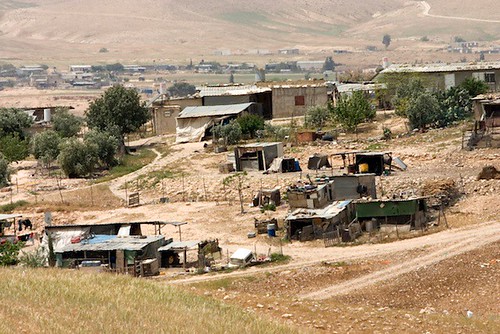 |
| Unrecognized Bedouin Village, Negev, Israel by Paulhrob (flickr) |
Israeli authorities have demolished the homes of about 300 Bedouins in a village in the southern Negev desert.
Al-Arakib, which had about 40 homes, is one of 45 Bedouin villages not recognised by Israeli authorities.
Police spokesman Mickey Rosenfeld confirmed the early-morning operation, saying the homes had been "illegally built" and were destroyed in line with a court ruling issued 11 years ago which was never implemented.
Noach said Israeli authorities had first given residents of al-Arakib a notice to evacaute on June 15, but that no action had followed, so the residents began to doubt that the demolition would occur.
But this morning, Israeli police arrived and forced residents to leave their homes within minutes, Noach said.
According to the Negev Co-existence Forum, around half of the 155,000 Bedouins in the Negev - all of whom are Israeli citizens - live in villages that are unrecognised by the government, without municipal services like water and electricity.


While my kids jump themselves silly on the trampoline (thank the heavens and stars for trampolines!!!) I can take a break and get my internet fix. It seems the buzz about Chas Freeman's withdrawal won't stop. The Washington Post published an editorial discrediting what is often called the “Israel Lobby” by painting it as a shadowy cabal of power-hungry leaders conspiring behind closed doors. However, Daniel Pipes himself reputedly crowed about the success of pro-Israeli elements, especially AIPAC's Steve Rosen, to start the momentum against Freeman.
What I see is a powerful lobby and its friends who can easily be seen as bearing much of the responsibility for Freeman's choice to withdraw. The paradox is that in getting what they want, the ouster of an unfriendly nominee for office, the pro-Israeli folks may have ended up giving support to those who argue that the “Israel Lobby” is indeed too powerful.

Obama's choice for chair of the National Intelligence Council withdrew today, raising questions about the Obama Administration's ability to stand up to what is called the “Israel Lobby.” Chas Freeman, a former Ambassador to Saudi Arabia, former Defense Department official under Reagan, and President of the Middle East Policy Council, was well regarded in intelligence and military circles. But he reputedly was insufficiently friendly to Israel and was guilty of making remarks that were regarded as critical of our ally and supportive of Palestinians and ending the occupation.
The National Intelligence Council is given the task of producing National Intelligence Estimates, the consensus estimates of the 16 US intelligence agencies. It was a hastily-produced NIE in 2002 that convinced Congress and many others that Iraq had WMD, especially nuclear weapons (or was close to producing them). Freeman's straight talking style reassured many, including Dan Froomkin, that an intelligence debacle like the one that occurred in 2002 and 2003 would not occur again. He has been described as a gadfly, speaking truth to power, and a “one man destroyer of groupthink,” exactly the kind of person you would want in this sort of position.
This brings up the question of how close to Israel should the United States be? Isn't a little tough love between friends warranted every now and then? Friends of Israel seem not to think so. It appears that both barrels were unleashed against Freeman, starting with rumors in the blogosphere, and growing into accusations that he was on the payroll of Saudi Arabia and had coddled China. It appears to have been too much for the new Obama Administration, prompting a sharply-worded statement by Freeman that accuses the Lobby of derailing his candidacy in order to obtain "control of the policy process."
Although I didn't have high hopes of a revolution coming from the Obama Administration in the realm of Middle East policy, I had hoped for sparks of change. This development sows the seeds of doubt that those sparks will ever light up.




 Posts
All Comments
Posts
All Comments


